Edenmere Mansions
The PeripheralEdenmere Mansions is a high-rise residence in Farringdon, owned in part by Aelita West and central to the investigation into her disappearance and presumed death. Its upper floors are at once a private home, a closely monitored security environment, and the site of a lethal attack: the building’s peculiar exterior hides a weapon that Flynne Fisher observes during a surveillance shift, while a later gathering there publicly commemorates Aelita and brings the danger into the open.
Setting and Architecture
Aelita occupied the fifty-fifth through fifty-seventh floors of Edenmere Mansions. From the outside, the building appeared almost black, though its surface was actually a very dark bronze-brown. Its facade was broken up by large, irregular rectangles, and the floors Flynne watched had no visible windows or had them shuttered. The severe, discontinuous geometry would later matter: a hostile device could alter its shape to resemble the building’s flat forms and blend against the facade.
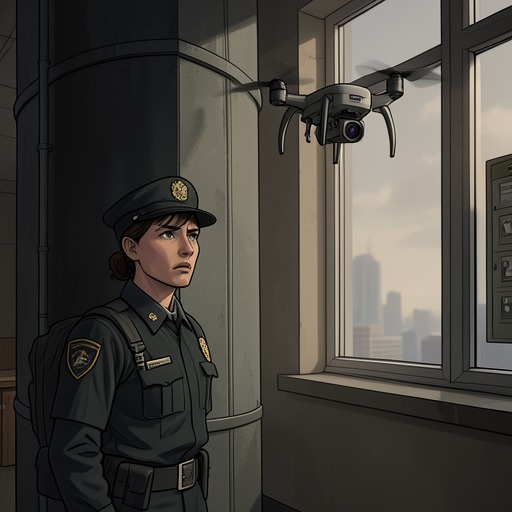
The upper levels presented an unusual surveillance problem. Flynne ascended in a quadcopter, but control and visibility shifted as she moved higher. At the fifty-sixth floor, a fold-out balcony and a frosted window marked the space she had previously watched; during a later visit, the window depolarized, revealing the interior. The building’s height, opaque surface, and changing access made it possible to observe the residence only intermittently, turning the facade into both a barrier and a screen.
Surveillance and the Attack
During her assigned shift, Flynne saw small, fast-moving surveillance craft around the building, which she compared to dragonflies. She was expected to drive them away rather than capture them, but by changing her approach angle and using a maneuver that made her quadcopter behave unpredictably, she came close enough to record an image. Behind frosted glass she could make out preparations for a party. Her task was nominally to chase the craft, yet the assignment gave her glimpses of activity inside Aelita’s residence.
On a later ascent, Flynne saw a rectangular object with four appendages climbing the exterior. It moved by somersaulting, passed her, and disappeared from view before she reached the upper floors. At the fifty-sixth floor, the surveillance craft and the object were gone; the window cleared, and Flynne saw a woman she recognized from the earlier gathering. When a door opened and a balcony railing began to rise, Flynne judged that the woman was in immediate danger. She diverted around the corner and climbed to the fifty-seventh floor.
There the climbing object had become nearly indistinguishable from the facade: bronze-black, flat, and sharply angular, with its limbs transformed into brackets. Unlike the surrounding wall, it remained dry while nearby surfaces were damp with condensation. Flynne described it as breathing. The object contained a swarm weapon. The woman who emerged onto the balcony was Aelita, identified afterward from an image shown to Flynne; the weapon killed her, and its swarm consumed her remains. The building’s facade had not merely concealed the device: its visual uniformity had allowed the threat to imitate the architecture.
The Residence and the Investigation
The scale of the attack became clearer through the subsequent inquiry. Lev Zubov explained that Aelita had hosted a cultural, partly semigovernmental event at her residence. It had originally been expected to celebrate the project associated with Flynne’s team, but Aelita reframed it after the earlier violence involving Daedra West. The event’s security was described as excellent, and Daedra had attended. The gathering’s purpose was not known to the investigators, and its strong security did not prevent Aelita’s later disappearance and death.
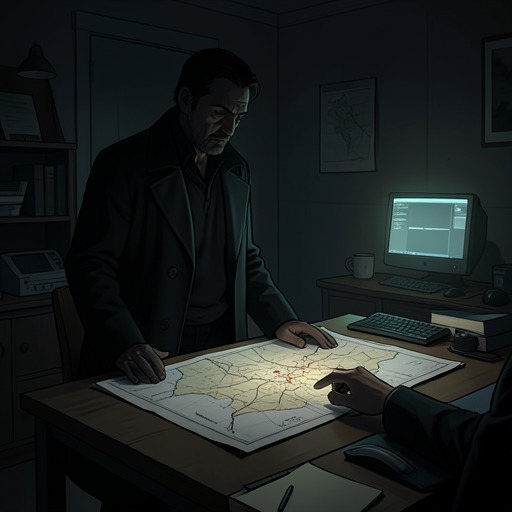
The timing of Flynne’s shift placed her inside the building’s security story. Ainsley Lowbeer established that the person on duty during the period when Aelita was believed to have vanished was not the ex-soldier the investigators first considered, but his sister, Flynne. Flynne’s account supplied the crucial observations: the climbing object, its movement up the exterior, its mimicry of the wall, and the attack at the balcony. Edenmere Mansions therefore figures not just as the location of a crime but as the physical evidence through which a distant, concealed killing becomes reconstructible.
The Celebration of Aelita’s Life
Later, Daedra invited Wilf Netherton to a gathering at Edenmere Mansions, identified as the residence where Flynne had seen Aelita murdered. The invitation named no purpose or tone beyond calling it a gathering; Wilf understood that powerful people might attend. The event was eventually presented to arriving guests as a celebration of Aelita West’s life, making the building a place of public remembrance as well as the private scene of her death.
The entrance was transformed for the occasion. A large inflatable structure served as a screening checkpoint, staffed by Michikoids in matching gray, quasi-military uniforms. Guests were scanned and examined through a sequence of robotic portals, a process that induced a moderately dissociative state and lasted roughly fifteen minutes. Afterward, an attendant directed them to the elevator and explained that personal security attendants had been admitted separately. The elaborate procedure emphasized that access to Aelita’s residence remained controlled, even during a memorial.
Inside, the upper-floor apartment had been opened into one large space: its windows were clear, and the interior walls had been removed or made to seem as though they had never existed. Conner Penske assessed the limited routes in and out, noting that the elevator was the only way to travel between the gathering and the floors below or above, though stairs connected the adjacent levels. He also identified numerous people who appeared to be security. The altered apartment could accommodate a crowd, but its openness and restricted vertical access made security and movement conspicuous.
Near the center of the room stood a floor-to-ceiling black screen. At first it seemed blank; from another angle, Flynne could discern a dim image of Aelita’s face. The display gave the gathering a literal, subdued focus on the woman whose absence it commemorated. Yet the memorial did not make the residence safe: Daedra warned Flynne that she was not protected there and criticized Wilf for bringing her. Edenmere Mansions thus retains its double character to the end of this account—a carefully managed venue for remembrance whose layered security cannot erase the threat that has already taken place within it.